The short answer
City air often gets worse in winter because of a weather pattern called a temperature inversion. Normally, warm air near the ground rises and carries pollution up and away. In an inversion, a layer of warmer air sits on top of colder air near the ground, like a lid. The pollution from cars, wood stoves and other burning can't rise, so it builds up day after day until a storm clears it out.
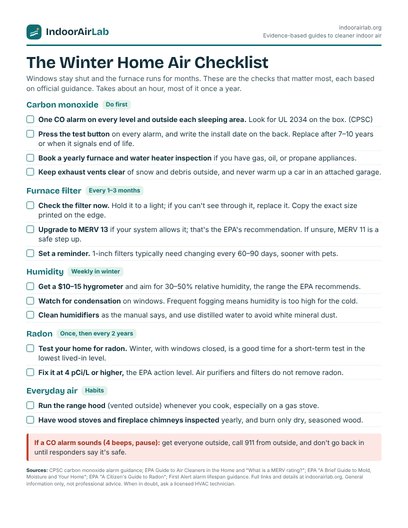
Get the free Winter Home Air Checklist: carbon monoxide, filters, humidity, and radon on one page.
Read the transcript
On cold, still days, many cities sit under a brown haze. The cause is not just more pollution. It is the weather.
In a temperature inversion, a layer of warm air above traps cool air and pollution close to the ground. In winter, that warm layer acts like a lid.
Mountain basins and valleys trap cold, heavy air. UCAR names Los Angeles, Denver and Mexico City as examples.
The winter recipe: calm winds, clear skies, long nights, and snow on the ground. The longer a high pressure system lasts, the stronger the inversion, and it usually takes a strong storm to clear it out.
The haze is mostly PM2.5, fine particles small enough to get deep into the lungs. Much of it forms in the air: up to 70% of particle pollution during Utah inversions is ammonium nitrate.
Wood smoke is the number two source of winter PM2.5 emissions in the U.S. One old wood stove emits about as much PM2.5 as eight old diesel school buses, by the EPA estimate.
The Salt Lake Valley averages five to six multi-day inversions a winter. Fairbanks, Alaska, with hills on three sides, has inversions that last for days.
The Air Quality Index runs from Good (0 to 50) to Hazardous (301 and up). Studies link particle pollution to heart and lung problems and aggravated asthma.
About 90% of Americans’ time is spent indoors. In a study of homes in six U.S. regions, about 62% of outdoor PM2.5 got inside on average, from 47% to 82% by city. In Toronto homes it was 52%.
A closed-up house also traps indoor pollution from cooking, candles, fireplaces and gas stoves.
In a randomized trial in Shanghai, a real HEPA purifier cut indoor PM2.5 from 96.2 to 41.3 micrograms per cubic meter in 48 hours, 57% lower than a sham filter.
In Taiwan homes, HEPA purifiers cut indoor PM2.5 from 33.5 to 17.2, and worked best with enough machines and windows kept closed. The EPA summary: portable air cleaners cut indoor PM2.5 by about half on average.
Two honest limits: health improvements are typically small, and HEPA catches particles, not gases.
On bad-air days: check the AQI, run a HEPA purifier sized by smoke CADR in the room you use most, keep it closed, use a MERV 13 filter if your system allows, cut indoor sources, and skip ozone generators.
You cannot control the air outside. You can improve the air inside. Every source is linked in the full guide at IndoorAirLab.org.
No narration: on-screen text, charts and stock footage.
That outdoor pollution doesn't stay outside. Studies of real homes find that about half to four-fifths of the fine particles outdoors (PM2.5) end up inside. The good news: in a randomized trial and in home studies, HEPA air purifiers cut indoor PM2.5 roughly in half.
What is a temperature inversion?
On a normal day, the sun warms the ground, and the ground warms the air just above it. Warm air rises, and as the National Center for Atmospheric Research (UCAR) puts it, "warm rising air near the ground lifts pollution away."
An inversion flips that. "A layer of warm air above traps cool air and pollution close to the ground," UCAR explains. In winter, that warm layer "acts like a lid."
Inversions are most common where cold, heavy air gets trapped in mountain basins and valleys. UCAR names Los Angeles, Denver and Mexico City as examples. Utah's Department of Environmental Quality says the recipe is calm winds, clear skies and long nights, often right after a snowstorm, with a high-pressure system sitting overhead. "The longer a high pressure system lasts, the longer and stronger the inversion," the agency says. It usually takes a strong storm to clear it out.
Why do inversions happen more in winter?
Utah's DEQ lists the ingredients: calm winds, clear skies and long nights. Snow on the valley floor reflects heat instead of absorbing it, which blocks the normal mixing that would carry pollution away.
Winter can also add more pollution to trap. In Fairbanks, Alaska, the state's environment department says very cold weather (below about -10 °F) raises PM2.5 levels, partly because people burn more fuel oil, wood and coal to stay warm.
What is actually in the haze?
The main winter problem is fine particles, called PM2.5: particles 2.5 microns wide or smaller, small enough to get deep into the lungs.
- Particles that form in the air. Utah's DEQ says most winter PM2.5 isn't emitted directly. It forms in the air from gases like nitrogen oxides (from vehicles and other burning), ammonia and volatile organic compounds. One product, ammonium nitrate, is "responsible for up to 70 percent of PM mass during inversions" in Utah. NOAA researchers have found the same chemistry in Utah's valleys and say Denver "often has the same problem in winter."
- Wood smoke. The EPA says "residential wood combustion is the second largest contributor of wintertime PM2.5 emissions" nationally. By its estimate, home wood smoke releases more PM2.5 than cars and trucks combined. The EPA also says one old, inefficient wood stove emits about as much PM2.5 as eight old diesel school buses, and U.S. homes have about 12.5 million wood stoves and 12 million fireplaces in use (Energy Information Administration figures).
- Vehicles and industry. Utah's DEQ lists vehicles, wood burning, area sources and industry as the main sources of the pollution that gets trapped.
Not everything in city air is a particle. Some pollutants are gases, like nitrogen dioxide. That matters indoors, because HEPA filters catch particles, not gases.
How bad does it get?
It varies a lot by city and by year. Two examples from official sources:
- Salt Lake Valley: about five to six multi-day inversion episodes a winter, and on average about 18 days a winter with PM2.5 above the national standard (Utah DEQ).
- Fairbanks: hills on three sides make it prone to inversions that can last "from hours to several consecutive days." It has been officially designated as not meeting the 24-hour PM2.5 standard since 2009 (Alaska DEC).
To check your own air, look up the Air Quality Index (AQI) for your area. Under the scale the EPA updated in 2024, here is what the PM2.5 numbers mean:
| AQI | Category | PM2.5 (µg/m³, 24-hour) |
|---|---|---|
| 0 to 50 | Good | 0 to 9.0 |
| 51 to 100 | Moderate | 9.1 to 35.4 |
| 101 to 150 | Unhealthy for sensitive groups | 35.5 to 55.4 |
| 151 to 200 | Unhealthy | 55.5 to 125.4 |
| 201 to 300 | Very unhealthy | 125.5 to 225.4 |
| 301 and up | Hazardous | 225.5 and up |
The EPA announced in 2025 that it is reconsidering the 2024 PM2.5 standard, so these breakpoints could change.
How does this pollution affect your health?
According to the EPA, fine particles can get deep into the lungs, and some may even reach the bloodstream. Studies have linked particle pollution to:
- premature death in people with heart or lung disease
- nonfatal heart attacks
- irregular heartbeat
- aggravated asthma
- decreased lung function
- more respiratory symptoms, like coughing, airway irritation or trouble breathing
The EPA says people with heart or lung disease, children, older adults, and people in minority and low-income communities are most likely to be affected, either because they are more sensitive or because they are exposed more.
This is general information, not medical advice. If you have asthma, heart disease or lung disease, ask your doctor what to do on bad-air days.
How much outdoor pollution gets inside your home?
A lot. The EPA notes that Americans spend about 90% of their time indoors, so what gets inside matters.
Researchers measure this with the infiltration factor: the share of outdoor PM2.5 that makes it indoors and stays in the air.
- MESA Air (U.S.): Researchers used 526 two-week indoor and outdoor samples to model thousands of homes in six U.S. regions. On average, 62% of outdoor PM2.5 got inside, from 47% in Winston-Salem, North Carolina, to 82% in New York. Infiltration was generally higher in the warm season, when air conditioning use and open windows were the biggest factors. In cold weather, outdoor temperature and forced-air heating were the best predictors.
- Toronto: In 46 homes, an average of 52% of outdoor PM2.5 got inside, with no significant difference between heating and non-heating seasons. Air exchange, central air conditioning and forced-air heating predicted how much got in.
So closing up the house in winter helps, but it doesn't keep the pollution out. In a typical home, about half or more of the outdoor fine particles still find a way in.
The catch: closing up traps indoor pollution too
Indoor air has its own sources. The EPA lists cooking, candles, fireplaces, unvented space heaters, kerosene heaters and smoking as sources of indoor particles. Gas stoves and other unvented combustion are the main indoor sources of nitrogen dioxide.
The EPA also notes that indoor concentrations of some pollutants are often 2 to 5 times higher than typical outdoor levels. In a closed-up winter house, that can matter as much as the smog outside.
The EPA's fixes for indoor sources:
- Use an exhaust fan vented outdoors over a gas stove.
- Keep gas appliances properly adjusted, and have the furnace, flues and chimney inspected every year.
- Open the flue when a fireplace is in use, and choose an EPA-certified wood stove with tight-fitting doors.
Do air purifiers help with city pollution?
For particles, yes. The evidence is consistent that a HEPA purifier lowers indoor PM2.5:
- Shanghai, 2015: In a randomized, double-blind crossover trial, 35 healthy college students lived in dorm rooms with a real purifier and a sham one for 48 hours each, with doors and windows closed. With real filtration, indoor PM2.5 fell 57%, from 96.2 to 41.3 µg/m³. Blood pressure and several markers of inflammation also dropped. Changes in lung function were not statistically significant.
- Taiwan homes, 2022: HEPA purifiers cut average indoor PM2.5 from 33.5 to 17.2 µg/m³. The share of outdoor PM2.5 found indoors fell from about 76% to 39%. The study found that the number of machines, the fan speed and open windows all affected how well they worked.
- Homes in New York and Ohio, 2018: In a placebo-controlled crossover study, a HEPA cleaner run for four weeks significantly lowered indoor black carbon (soot) and PM2.5. A dummy unit did not.
- The EPA's summary: portable air cleaners can reduce indoor PM2.5 in living rooms and bedrooms by about 50% on average.
Two limits to know. First, the EPA says the health improvements from air cleaners "are typically small and not always noticeable to the individual." Second, HEPA filters catch particles, not gases. The EPA says activated carbon can remove gases "provided that there is a large amount of material used in the filter." See HEPA vs carbon filters.
What to do on bad-air days
- Check the AQI for your area before you open windows or exercise outside.
- Run a HEPA purifier in the room where you spend the most time, especially the bedroom. Size it by smoke CADR: what size air purifier you need.
- Keep the doors and windows closed in that room while the purifier runs. In the Taiwan study, open windows made purifiers less effective.
- Use a good HVAC filter. The EPA recommends MERV 13 or the highest your system can handle, and running the fan longer. See which MERV rating to use.
- Cut indoor sources. Run a range hood vented outdoors when you cook on a gas stove, and skip candles and the fireplace on bad-air days.
- Skip ozone-making "air cleaners." The EPA says no federal agency has approved ozone generators for use in occupied spaces.
Frequently asked questions
How long do winter inversions last?
From hours to several days. Utah's DEQ says the Salt Lake Valley has about five to six multi-day episodes in a typical winter, and pollution builds the longer one lasts. It usually takes a strong storm or low-pressure system to clear the air.
Does closing my windows keep the pollution out?
Only partly. In the studies above, about half or more of the outdoor PM2.5 still got inside. Closing up helps, but filtration does more.
Can an air purifier remove smog?
It removes the particle part of smog well. It does little for gases like nitrogen dioxide, unless it has a large amount of activated carbon.
Sources
- UCAR Center for Science Education. How weather affects air quality. scied.ucar.edu
- UCAR Center for Science Education. Temperature inversion. scied.ucar.edu
- Utah Department of Environmental Quality. Inversions. deq.utah.gov
- NOAA Chemical Sciences Laboratory. Winter air pollution in Western valleys (2019). csl.noaa.gov
- Alaska Department of Environmental Conservation. Fairbanks PM2.5 background. dec.alaska.gov
- U.S. EPA. Burn Wise: facts and figures. epa.gov
- U.S. EPA. Health and environmental effects of particulate matter. epa.gov
- U.S. EPA. PM NAAQS and the Air Quality Index, fact sheet (2024). epa.gov
- U.S. EPA. National Ambient Air Quality Standards for PM, including the 2025 reconsideration notice. epa.gov
- U.S. EPA. Report on the Environment: indoor air quality. epa.gov
- U.S. EPA. Indoor particulate matter. epa.gov
- U.S. EPA. Nitrogen dioxide's impact on indoor air quality. epa.gov
- U.S. EPA. Guide to Air Cleaners in the Home, 2nd edition. epa.gov
- Allen RW, Adar SD, Avol E, et al. Modeling the residential infiltration of outdoor PM2.5 in MESA Air. Environmental Health Perspectives (2012). doi.org
- Clark NA, Allen RW, Hystad P, et al. Exploring variation and predictors of residential fine particulate matter infiltration. Int J Environ Res Public Health (2010). doi.org
- Chen R, et al. Cardiopulmonary benefits of reducing indoor particles of outdoor origin: a randomized, double-blind crossover trial of air purifiers. Journal of the American College of Cardiology (2015), as summarized by Healio. healio.com
- Chen CF, Hsu CH, Chang YJ, et al. Efficacy of HEPA air cleaner on improving indoor particulate matter 2.5 concentration. Int J Environ Res Public Health (2022). doi.org
- Effectiveness of a portable air cleaner in removing aerosol particles in homes close to highways. Indoor Air (2018). stacks.cdc.gov