The short answer
Buy a carbon monoxide alarm that is listed to UL 2034, has a digital display that shows the CO level and the peak reading, and runs on a sealed 10-year battery (or plugs in with a battery backup). Put one on every level of your home and one outside each sleeping area, and replace each alarm when its end-of-life signal sounds, usually after 7 to 10 years. A standalone CO alarm from Kidde or First Alert with those features costs roughly $35 to $50. Skip unbranded no-name detectors: in 2022 the CPSC warned people to stop using a cheap Amazon model that failed to alarm at all in its tests.
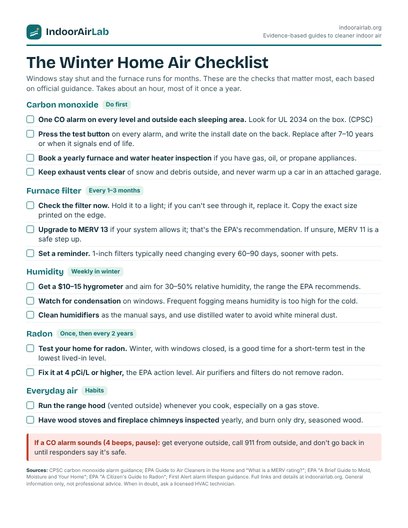
Get the free Winter Home Air Checklist: carbon monoxide, filters, humidity, and radon on one page.
An air purifier does not remove carbon monoxide. Neither does a HEPA or carbon filter. The only protection is an alarm plus well-maintained fuel-burning appliances.
Why this matters in winter
Carbon monoxide is a gas you cannot see, smell, or taste. It comes from anything that burns fuel: gas furnaces, gas water heaters, gas ranges, fireplaces, wood stoves, oil furnaces, generators, and cars in an attached garage. The CDC estimates that about 480 people in the US die each year from carbon monoxide poisoning not related to fires, and that exposures are more common in fall and winter, when furnaces and heaters are running and windows are closed.
Early symptoms feel like the flu: headache, dizziness, weakness, nausea, and confusion. People who are asleep can be overcome before they notice anything, which is why an alarm outside the bedrooms matters most.
What to look for in a CO alarm
UL 2034 listing. This is the US safety standard for home CO alarms. Look for the UL (or ETL/CSA certification to UL 2034) mark on the box and the alarm itself. It is the clearest way to avoid the class of bargain detectors the CPSC warned about.
A digital display with peak memory. A display shows the current CO level in parts per million (ppm). Peak memory shows the highest level since you last reset it. That tells you whether something happened while you were away or asleep, and it is useful information for firefighters or a doctor.
Power that will not lapse. A sealed 10-year lithium battery means no battery changes and no temptation to "borrow" the battery. A plug-in alarm needs a battery backup so it still works in a power outage, which is exactly when people run generators and gas heaters.
Interconnection or smart alerts (optional). Interconnected alarms all sound when one detects CO. Wi-Fi models send a phone alert, which is useful for a cabin, a rental, or a parent's house.
Our picks
We have not yet tested CO alarms ourselves. These picks are based on published specifications and independent reviews. Check that the exact model you buy says UL 2034 on the box.
| Type | Example model | Power | Display | Why pick it |
|---|---|---|---|---|
| Best overall standalone | Kidde C3010D | Sealed 10-year battery | Yes, with peak memory | No batteries to change; shows current and peak CO |
| Alternative standalone | First Alert CO5-B10D (replaces the CO710) | Sealed 10-year battery | Yes | Same idea from the other major brand |
| Best plug-in with phone alerts | Kidde COPDW | Plug-in with AA backup | Yes, updates every 15 seconds | App alerts; works with Alexa and Google Home |
| Smart smoke + CO combo | First Alert SC5 | Battery or hardwired | Voice alerts instead of a numeric display | Says which hazard and which room; interconnects with other First Alert alarms |
For people with heart or lung conditions: UL 2034 alarms are designed not to sound at low levels (see the next section). If someone in the home has asthma, heart disease, or is pregnant, some home inspectors recommend adding a low-level CO monitor that reads and alerts below the UL thresholds. Treat it as an extra, never a replacement for a listed alarm.
How sensitive are CO alarms?
UL 2034 sets a time window for each concentration. An alarm must sound:
| CO level | Alarm must sound within |
|---|---|
| 70 ppm | 60 to 240 minutes |
| 150 ppm | 10 to 50 minutes |
| 400 ppm | 4 to 15 minutes |
It must also not alarm at a steady 30 ppm for 30 days. That rule cuts down false alarms, but it means a low, chronic leak can go unnoticed by a standard alarm. A display model helps here: if you see small numbers that keep coming back, have your furnace and water heater checked.
Where to install a carbon monoxide detector
The CPSC recommends a CO alarm on each level of the home and outside separate sleeping areas. Kidde adds that extra alarms can go about 5 to 20 feet from fuel-burning appliances like a furnace, water heater, or fireplace.
- Outside every sleeping area. In a hallway that serves several bedrooms, one alarm can cover them. Separate bedroom wings need their own.
- Every level, including the basement. Basements usually hold the furnace and water heater.
- Near the door to an attached garage, inside the house, not in the garage.
- Not right next to a furnace, range, or fireplace, where brief puffs can cause nuisance alarms. Not in dead-air corners, next to windows or doors, or in steamy bathrooms.
- Height: CO mixes with room air, so wall, ceiling, or tabletop placement all work. Follow the height in your alarm's manual.
Colorado law: Colorado requires an operational CO alarm within 15 feet of the entrance to each bedroom in homes that have a fuel-fired heater or appliance, a fireplace, or an attached garage. It applies when a home is sold or when permitted remodeling, appliance replacement, or additions happen. Check your own state's rules too; many states have similar laws.
How many carbon monoxide detectors do I need?
Count your levels, then count your separate sleeping areas. A one-story ranch with all bedrooms on one hallway might need just one or two. A two-story home with a basement, bedrooms upstairs, and an attached garage usually needs at least three: basement, main level near the garage door, and the upstairs bedroom hallway. Add one near any room with a fireplace or wood stove that you use often.
Do smoke detectors detect carbon monoxide?
Only if the box says "smoke and carbon monoxide" or "combination." A regular smoke alarm does not detect CO. Combination alarms are convenient, but a separate CO alarm with a display gives you the actual reading. Many homes use combination units in hallways and a display CO alarm near the furnace or bedrooms.
Do carbon monoxide detectors detect natural gas?
No. Natural gas (methane) and propane are a different problem: an explosion and fire risk, not a poisoning risk. A CO alarm will not sound for a gas leak. If you smell rotten eggs, leave and call your gas company from outside. If you want an alarm for gas leaks, buy one labeled as an explosive-gas alarm or a combination CO and explosive-gas alarm.
Do I need one if I have oil heat or an all-electric home?
Oil heat: yes. Oil furnaces and boilers burn fuel and can produce carbon monoxide, the same as gas.
All-electric home: you still need one if you have a fireplace, wood stove, attached garage, or ever run a generator. If your home truly has none of those, the risk is much lower, but a single alarm is cheap insurance, especially if you might use a gas or kerosene heater during an outage.
How long do carbon monoxide detectors last?
The sensor wears out. First Alert says most CO alarms last 5 to 7 years and recommends replacing any alarm after 7 years. Sealed-battery models are designed for 10 years and chirp at end of life. Write the install date on the back of every alarm.
Why is my carbon monoxide detector beeping?
Patterns vary by brand, so check your manual. For First Alert alarms:
| Sound | Meaning | What to do |
|---|---|---|
| 4 beeps, pause, repeat | CO detected | Get everyone outside, call 911, and stay out until responders say it is safe |
| 1 chirp every minute | Low battery | Replace the battery (and the backup battery on plug-ins) |
| 5 chirps every minute | End of life | Replace the whole alarm |
Never silence a 4-beep alarm and stay inside to "see if it stops." Go outside first.
What to do if your alarm goes off
- Get everyone, including pets, outside into fresh air right away.
- Call 911 from outside.
- Do not go back in until firefighters say it is safe.
- Have a qualified technician inspect fuel-burning appliances before you use them again.
Prevention that matters more than the alarm
- Have your furnace, water heater, and any other fuel-burning appliances inspected every year.
- Never run a generator, grill, or camp stove indoors or in a garage, even with the door open.
- Never warm up a car in an attached garage.
- Keep chimney and vent outlets clear of snow and debris.
Sources
- CDC: carbon monoxide poisoning is highest during cold weather
- CPSC: warning to stop using HECOPRO CO detectors (2022)
- BRK (First Alert): what levels of CO cause an alarm (UL 2034)
- First Alert: what the beeps mean and alarm life span
- Kidde: placement of CO alarms
- Kidde C3010D product page
- First Alert CO710 product page (discontinued; replacement listed)
- Security.org: CO detectors reviewed (First Alert SC5, Kidde COPDW)
- Colorado Revised Statutes 38-45-102: CO alarm requirements
- Structure Tech: why UL-listed alarms miss low CO levels