The short answer
For most bedrooms, buy a cool-mist humidifier with a built-in humidity sensor, fill it with distilled water, and aim for 30% to 50% humidity. If you would rather use tap water, or you need to cover a large open area, buy an evaporative model instead: it uses a wick and a fan, so it does not put mineral dust into the air. Whichever type you choose, empty it every day and clean it every third day. A dirty humidifier can do more harm than dry air.
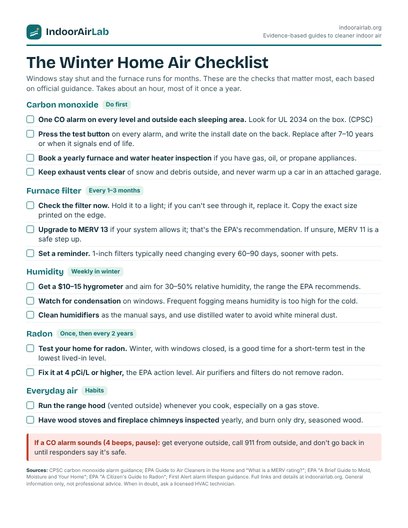
Get the free Winter Home Air Checklist: carbon monoxide, filters, humidity, and radon on one page.
Read the transcript
Waking up with a dry throat and getting zapped by every doorknob? Your air is probably too dry.
The Consumer Product Safety Commission and Mayo Clinic both say to keep indoor humidity between 30% and 50%.
A cheap hygrometer tells you your actual number, so you're not guessing.
But more isn't better. Above about 60%, moisture can condense on surfaces and let mold and bacteria grow.
Seeing white dust on your furniture? That's minerals from tap water. Switching to distilled water fixes it.
Change the water every day and clean the tank every few days, because dirty humidifiers can grow bacteria and spray it into the air.
And with little kids at home, skip the hot steam vaporizers. Spilled hot water can burn.
Grab the free Winter Home Air Checklist at IndoorAirLab.org.
Narration uses an AI voice.
An inexpensive hygrometer tells you your actual humidity. Buy one before you buy a humidifier, because you may not need one in every room.
What humidity should your home be?
The Mayo Clinic says to keep indoor humidity between 30% and 50%. The EPA's humidifier guidance sets the same ceiling: do not let indoor humidity go above 50%.
| Humidity | What happens |
|---|---|
| Below 30% | Dry skin, irritated nose and throat, itchy eyes |
| 30% to 50% | The target range |
| Above 50% | Condensation, and growth of mold, bacteria, and dust mites, which can trigger allergy and asthma flare-ups |
Watch your windows in cold weather. If you see water forming on windows or walls, the EPA says to turn the humidifier down, move it, or run it less.
Ultrasonic vs evaporative vs warm mist
There are three common types of portable humidifier. They differ most in what they put into the air besides water.
| Type | How it works | Good | Watch out for |
|---|---|---|---|
| Ultrasonic (cool mist) | A vibrating plate turns water into a fine mist | Quiet, cheap, no wick to replace | Sends minerals and any germs in the water into the air. Needs distilled water and regular cleaning |
| Evaporative (cool) | A fan blows air through a wet wick | Little or no mineral dust, works with tap water, hard to over-humidify | Fan noise on high; wicks need replacing |
| Warm mist / steam | Boils water and releases steam | Little or no mineral dust | Burn risk from hot water and steam; uses more electricity |
The EPA says ultrasonic and impeller humidifiers disperse the most minerals and microorganisms. Evaporative and steam models generally release little or none, though any type can grow microbes if water sits in the tank.
If you have children: the EPA says to keep steam vaporizers out of their reach, and the Mayo Clinic advises against buying a steam vaporizer at all if you have children, because spilled hot water can cause burns. Choose a cool-mist type.
If you have asthma or allergies: the Mayo Clinic recommends talking to your doctor before using a humidifier. Mist from a dirty unit can carry bacteria or mold, and humidity that is too high feeds dust mites and mold.
Our picks
We have not yet tested humidifiers ourselves. These picks are based on manufacturer specifications and on hands-on testing published by Bob Vila's review team, which ran each model for days or weeks. Coverage figures come from the manufacturers.
| Best for | Model | Type | Tank | Covers up to | What stands out |
|---|---|---|---|---|---|
| Bedrooms | Levoit Classic 300S | Ultrasonic | 1.58 gal (6 L) | 505 sq ft | Auto mode holds a set humidity; 30 dB or less; up to 60 hours on low |
| Large rooms and open floor plans | Levoit Superior 6000S | Evaporative | 6 gal | 3,000 sq ft | Works with tap water; held its target humidity in testing; up to 72 hours |
| Large spaces on a budget | Aircare Mini-Console | Evaporative | 2.5 gal | 2,600 sq ft | Built-in humidistat; up to 36 hours |
| Living areas | Vornado Evap40 | Evaporative | 4 gal | 1,000 sq ft | Strong output for the price |
| Small or child's bedroom | Levoit Sprout | Evaporative | 1 gal | 219 sq ft | About 20 dB in sleep mode; night light |
| Whole house, on your furnace | AprilAire 600 | Bypass evaporative | Plumbed in | 5,000 sq ft (tight homes) | 17 gallons per day; automatic control with an outdoor sensor |
Levoit Classic 300S. A top-fill ultrasonic model with app control. Levoit rates it for rooms of 215 to 505 square feet and lists it at $79.99. Its auto mode adjusts mist to hold 40% to 50% humidity or a target you set, which guards against over-humidifying. As an ultrasonic model, it needs distilled water to avoid white dust.
Levoit Superior 6000S. Bob Vila's testers named it the best evaporative humidifier of 2026 and the best room humidifier for large rooms. They found it quiet and good at holding a target humidity. The trade-offs are size (it stands almost 27 inches tall), a heavy tank, and a higher price.
Aircare Mini-Console. The value pick for big spaces. In testing it struggled to get past 30% humidity in cold weather without running on high, where it reached about 58 dB. That is fine for a living area and loud for a bedroom.
Vornado Evap40. Testers kept a basement near 45% humidity with it. It lost points for cleaning: the open spouts are hard to scrub, and it makes a glugging sound as the tanks drain.
Levoit Sprout. A small evaporative model built for nurseries. Testers noted the tank lid rests in place and does not screw shut, so keep it out of a child's reach.
AprilAire 600. A whole-house humidifier mounts on the ductwork of a forced-air furnace and connects to your water line, so there is no tank to fill or scrub. The water panel inside is replaced once or twice per heating season. These are sold and installed through HVAC contractors, and the installed cost is far higher than a portable unit. It makes the most sense if your whole home is dry every winter and you already have ductwork.
What size humidifier do you need?
Match the unit to the room, the same way you would a purifier.
- Measure the room in square feet (length times width) and compare it to the coverage the manufacturer lists.
- One room or several? A bedroom unit will not humidify a house. For several rooms, use a console evaporative model in a central spot, or a whole-house unit.
- Tank size sets how often you refill, not how much area it covers. A larger tank runs longer between fills.
- Cold, dry weather is harder. In testing, one console model could not pass 30% in cold weather without running on high. If your home is very dry, choose a unit rated for more area than you have.
Why is there white dust on my furniture?
White dust is minerals from tap water. An ultrasonic humidifier turns everything in the water into mist, including dissolved minerals, which settle as a fine white powder.
- Use distilled water. The EPA says distillation is the most effective way to remove minerals. Water labeled spring, artesian, or mineral has not been demineralized.
- Demineralization cartridges can help if the manufacturer supplies them, but the EPA says their effectiveness varies widely. If you still see dust, minerals are getting through.
- Or switch to an evaporative model, which leaves the minerals behind in the wick.
How often should you clean a humidifier?
The EPA and the Mayo Clinic give the same schedule for portable units:
| How often | What to do |
|---|---|
| Every day | Unplug it, empty the tank, wipe it dry, and refill with fresh water |
| Every third day | Scrub the tank and any surface that touches water to remove scale and film |
| End of season | Clean it, dry every part, throw away used filters or cartridges, and store it dry |
Follow the manufacturer's cleaning instructions first. If there are none, the EPA says to use a 3% hydrogen peroxide solution, then rinse thoroughly with several changes of tap water so you do not breathe in the cleaner later. Do not add anything to the water unless the manufacturer says to.
If you develop breathing symptoms you think are linked to the humidifier, the EPA says to stop using it and talk to a doctor, even if you have been cleaning it properly.
Do you need a humidifier at all?
Not always. Check a hygrometer first. If your rooms sit at 35% to 45% in winter, you do not need one. If only the bedroom is dry, one bedroom unit is enough. If the whole house reads below 30% for months, a console evaporative model or a whole-house unit will do more than several small ones.
A humidifier adds moisture. It does not clean the air. For smoke, dust, and allergens, see what size air purifier you need. And while you are getting the house ready for winter, check your carbon monoxide alarms and your furnace filter.